Tuesday, 14 March 2017

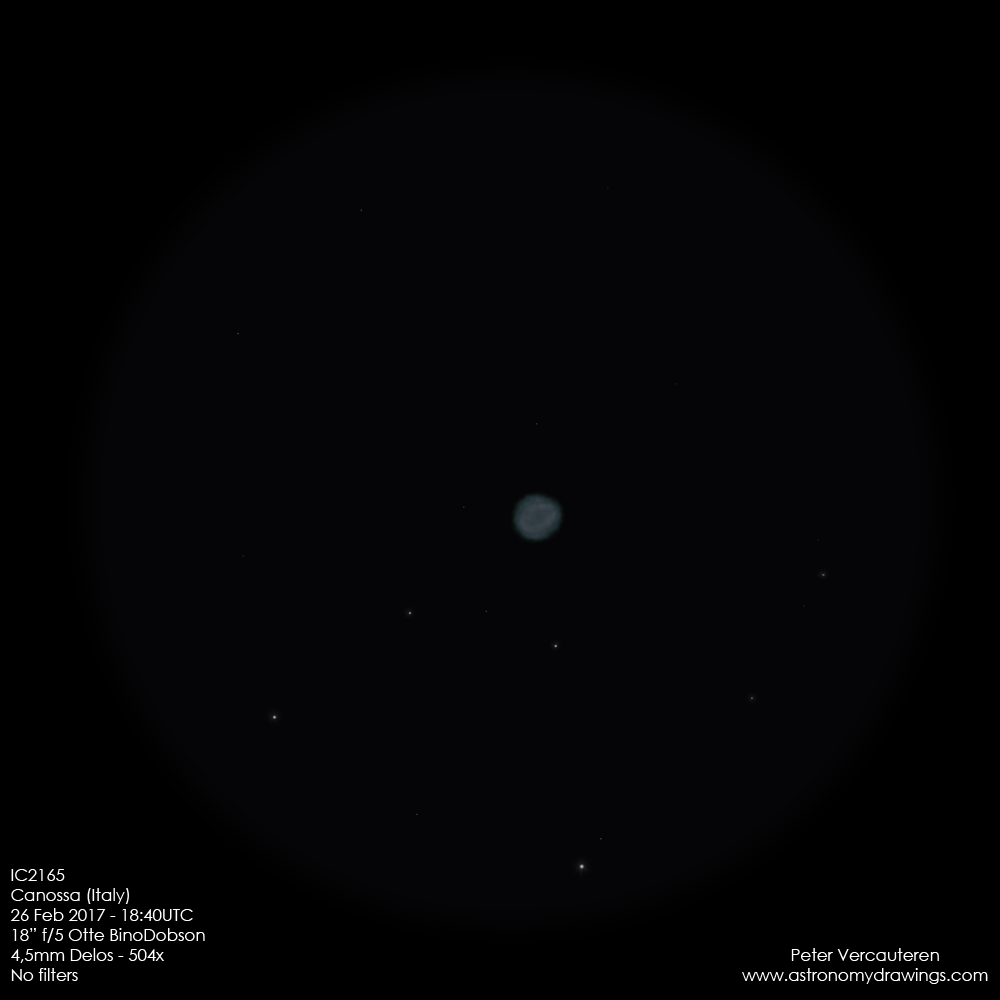
Just another planetary... or not?

As I explained already several times, planetary nebulae are formed when an old star becomes unstable and dies. The fusion process comes to a halt, making the core collapse whereas the outer layers of the star are expelled and form a gaseous bubble. Hence the name "planetary" because these nebulae are usually small and round and therefore somewhat resemble a planet.

The one I'm presenting to you now's denominated IC2165 and can be found in the constellation of Canis Major, the great dog, almost half-way between bright Sirius and Orion's left knee. It appears very small because it's quite distant, being more than 6.000 lightyears away from us, but as with most planetaries it's still quite bright and supports high magnifications well. Yet it was difficult for me to make out any detail in it, although I did see a brighter, elongated inner shell. This inner shell's caused by the collapse of the central star whereas the fainter, large bubble consists of gas that had already been expelled earlier, during the star's last, unstable phase. The inner shell obviously travels a lot faster than the outer, being propelled by the sudden collapse of the star, and is quickly nearing the outer shell where both will merge and eventually dissipate into space together under the strong stellar wind from the collapse. Scientists believe that this nebula has entered a late-intermediate phase due to the proximity of the inner shell to the outer and the much faded central star, which was indeed invisible to me.  
Friday, 10 March 2017

An exploded jellyfish

Actually, the title of this blog post's a bit misleading because in reality the explosion caused the jellyfish and not the other way around, but I thought it sounded nicer this way. Now what on Earth is going on here? The nebulous filaments you see on this sketch are the remnants of a supernova explosion, quite similar to the ones that caused the Crab and the Veil nebulas. The Jellyfish Nebula (or IC443 if you like) decorates the winter constellation of Gemini and contrary to its two more famous counterparts it's a lot more difficult to observe. For starters, it lies much further away from us - some 5.000 lightyears compared to 1.470 for the Veil - and it's probably much older and therefore more dissolved into space. Given its large size and considerable distance we find that the Jellyfish extends 70 lightyears across, much more than the Veil's 50 lightyears. But this doesn't mean that the Jellyfish isn't an interesting object at all; much on the contrary I would say. Yes, it does take a reasonable amount of telescope and a dark sky to spot it, but as you can see on my sketch it does have a quality that is no second to many of the brighter nebulae in the sky. If you get the chance to observe it through a really big telescope under a really dark sky the delicate whisps and filaments reveal themselves just in the same way as they do in the Veil. All that you see is gas and other matter that's blown away by the incredible shockwave that the supernova explosion generated. Remember that a supernova releases more energy in a fraction of a second as our Sun produces in its entire life! The initial velocities of such a shockwave can be as high as 30.000km/s, or one tenth on the speed of light, and the resulting gas bubble's heated up to millions of °C! Of course, our Jellyfish has slowed down (30km/s) and also cooled down (10.000°C) considerably over time and probably within the next centuries its expansion speed may fall below the local speed of sound. Unfortunately there's still great uncertainty about the age of this nebula with estimates varying between 3.000 and 30.000 years. Recent observations with NASA's sophisticated X-ray telescope, however, seem to confirm the latter figure. 

The Jellyfish is also an interesting object from another perspective. It lies within a dense molecular cloud complex and therefore scientists have studies this nebula to a great extent in order to see how the expanding blastwave interacts with the surrounding gas clouds. It's also been suggested that the star that caused the Jellyfish explosion had such a short life - perhaps as short as 30 million years - that it was still enveloped by its original birth nebula when the supernova went off. All that's left of it now is a tiny neutron star, merely 10km across but with a mass that's perhaps twice as much as our Sun's. Imagine how heavy it must be and how great the force must have been that was able to compress all of that matter into such a tiny ball! It's spinning rapidly whilst emitting radiation in a beam, much like a lighthouse on speed. Such pulsating neutron stars (or pulsars) can turn at a speed of several hundred rotations per second and they do this with such an accuracy that make them the most precise clocks in the universe.

Wednesday, 8 March 2017

The baby boom galaxy

In my previous post I told you about the close encounter of the M81 and M82 galaxies which happened a few hundred million years ago. As you could see on the sketch, M81 remained fairly intact after the M82 fly-by. Now have a look at the latter. Although evidence of a spiral structure has been found recently, it's obvious that this small galaxy has been deformed dramatically by the tidal forces that the encounter generated. Gas and dust have been stirred up severely and the main dark structures can already be observed through a small telescope. 

Now, what would be the consequence of all this, you might ask? Is this galaxy headed for destruction? Will it blow up? Fall apart?... Nothing of the kind! Actually, this galaxy's become a baby boomer! In another post I explained that galaxies are a bit like a cup of coffee. Older galaxies are like a cup in which the milk has been mixed completely. It's cooling down and the coffee has a plain, unattractive light-brown colour. Not much activity going on in that. Young and active galaxies, such as our own, are like coffee to which the milk's only just been added and which you're giving a good stir. The white trails of milk form a spiral pattern in the coffee and there's a lot of activity going on... clouds of gas and matter that are swirling, contracting and... forming stars. Now consider this little bugger. Here the milk's not simply been added and stirred. Oh no! In this case a whole can of milk was poured in at once and the coffee and milk are splashing everywhere! How about that for activity! The Hubble space telescope's discovered 197 starburst clusters in the core of this galaxy with an average mass of 200.000 Suns. This means that every single one of them is like a supermassive globular cluster of stars, all within the galaxy's central region! Stars in the core of this galaxy are being born ten times faster than they are in our entire Milky Way and consequently there are also much more supernova explosions when the biggest of those stars reach the end of their very short lives. Exactly three years ago one of these supernovae happened and could even be observed through ordinary binoculars. Here you can see the sketch that I made at the time with my former 18" telescope. The high supernova rate (about one every ten years) generates incredible superwinds that blow out matter from the galaxy's core as you can clearly see on my sketch. Most of this matter will eventually fall back into the galaxy (remember the splashing coffee) or form small and active satellite galaxies such as UGC5336 near M81.   

The universe never ceases to amaze us...


Monday, 6 March 2017

A perfect spiral

M81, or the 81st object on Charles Messier's list, is the brightest member of one of the nearest galaxy clusters to our own. Actually this cluster's much larger than ours and contains no less than 34 members, although the larger part of those are dwarf galaxies that are beyond the reach of most amateur telescopes. A few others, however, are a real treat such as strange M82 which lies almost as close to M81 as measures the diameter of our Milky Way (I'll tell you more about M82 in my next post). On the other side of the cluster lies NGC4236, of which I told you here recently, at a distance of 12° in our sky or almost 4 million lightyears from M81. All of these galaxies are physically interacting with each other and especially M81 and M82 (and less known NGC3077) have a very strong bond. A few hundred million years ago a close encounter took place between M81 and M82 during which the latter was dramatically deformed. M81 on the other hand survived this encounter almost intact but still the enormous tidal forces generated a lot of star forming activity in it. It is difficult to see the many star forming regions with amateur telescopes but you might notice the brighter knots in the spiral arm just below the two little stars below the nucleus. The interaction with M82 has also sucked out a lot of matter from both galaxies which led to the formation of filamentary structures in between them. Some of these gas glouds have fallen back into M81, leading to even more starburst activity.

For those of you with a keen eye, you might notice a faint patch towards the left-hand border of my sketch. This is an irregular dwarf galaxy denominated UGC5336 (or Holmberg IX) which is a close companion to M81. It's very young, with an estimated age of merely 200 million years and therefore scientists believe that it may have formed out of the debris left from the M82 fly-by. 

The M81 galaxy cluster's estimated to be 12 million lightyears away from us.


Sunday, 5 March 2017

Decorated with a rosette

The night's sky is the most bewildering spectacle that we, insignificant human beings, may behold. That is, if you go to one of the few areas left on our planet that aren't contaminated by useless street lights that we in our stupidity believe to make our lives safer. But if you're lucky enough to dwell in one of these rare places of exceptional darkness and the weather gods play in your favour too, try to look up a little more and you'll understand why we astronomers live our hobby with such great passion. While you're at it, try to ignore the imposing constellation of Orion which carries the famous nebula in its sword. Instead, look a bit to the left, to the almost indistinguishable constellation of Monoceros, the unicorn. Even though it doesn't contain any bright stars, the Milky Way decorates it with one of its brighter knots which means that you're bound to find lots of treasure in it. The most famous treasure is without question the glorious Rosette Nebula, which is so amazingly complex that it has no less than four scientific denominators: NGC2237-2238-2239-2246, plus another one for the bright and young star cluster within it (NGC2244). 

It is visible to the naked eye, but as I suggested you need a really dark sky for it. The Rosette is yet another area of massive star formation in our galaxy and with its radius of 20 lightyears it's also one of the biggest, even twice as big as the great Orion Nebula! The reason why it's so much fainter is because it lies 5.000 lightyears away, or almost four times further than its more famous counterpart. The Rosette proves to be a challenging object exactly because of its size. The frail light that eventually reaches us from it, is smeared out over a surface that would fit four full Moons! Luckily a binoscope offers the advantage that you can keep magnification lower for the same light gathering power so I managed to capture most of the nebula in the same field of view and with remarkable brightness. Look how the stunning Rosette's swirling around the newborn stars that are its offspring! Look at all those filaments of gas and dark matter that are yet contracting to form even hundreds of other new stars! Isn't it about time that we all turn the bl**dy lights off and start admiring what lies out there again, as did all of our forebeareres, instead of living in this tiny little world of fashion and social media?


Tuesday, 28 February 2017

On the border of intergalactic space

Yes, I know... Here I am again with a sketch on which you can't see a bl**dy thing unless in total darkness and after staring at the computer screen for three hours with averted vision. But Berkeley 19 (Be 19) is a very interesting open cluster, meaning that it's extremely old (perhaps even older than our galaxy itself) and that it lies at a distance of 25.000 lightyears. In other words... this cluster lies BEYOND the outer arm of our galaxy! If you go any further, you'll find yourself in the absolute void of intergalactic space! 

To give you an idea what it would be like to live there... Imagine a world where half of the year the only thing you see is the Milky Way splitting the sky in two, with perhaps here and there some stray stars, and the other half the sky looks completely empty and black to the naked eye. If you're lucky, you might spot a few faint, hazy patches of nearby galaxies such as Andromeda or M33, but that's it. For the rest the sky would appear as total emptiness. Well, it would have its compensations because for sure the astrologists would be out of business. :-)

But let's return to Earth. When I found out about this distant cluster I was immediately fascinated by it because of its extreme location. I had already tried a few times to spot it but since my telescope's database doesn't know it, I had to look for it visually (without a finderscope) and it turned out to be more difficult than I had imagined, even though it lies at only a small step from bright star Elnath. When I had eventually found the right place according to the map and with a magnification of 104x... I didn't see anything. Neither at 190x. At 285x I thought to have seen something (maybe) and only at 504x I've seen some of the cluster's stars. Centrally I noted a sort of a pentagon and there were two detached lobes, one above and one below. 

I could of course render extremely difficult objects like these a bit brighter on the sketch, making them more easily visible for you. But that wouldn't be right in my opinion because it might give you the impression that it was just as (clearly) visible through my telescope, whereas it wasn't. Sketchers like me thread on a very difficult line between realism and artistic expression. Sometimes I've not rendered an object bright enough, sometimes I've overdone it a bit. It's so difficult to tell how bright an object really was at the eyepiece, especially since I'm doing the processing on the pc sometimes days after the observation itself. In the end I try my best to give you the same experience as I had. Perhaps it's also more rewarding for you this way... 

"I've seen it!!!" :-)   

Friday, 24 February 2017

Near but so easily overlooked

Some astronomical objects receive far less attention than they rightfully deserve. There may be many reasons for this, as for example that the object in question's too challenging. But that's a real pity because sometimes even the more difficult objects can turn out to be extremely rewarding. 

NGC4236 is a galaxy that resides in the tail of Draco, the dragon. It's a member of the M81-M82 group and therefore it lies only 11,7 million lightyears away from us. In astronomical terms, that's our backyard. Actually, NGC4236's only slightly smaller than our Milky Way and therefore it's by far the largest group member, significantly bigger than it's two famous neighbours. We also see this galaxy under a shallow angle, meaning that its light isn't dispersed over such a large area as is the case with galaxies we see face-on, like M33 for example. In short, NGC4236 has all that it takes to become one of the most popular astronomical objects. And yet, it isn't as it's surprisingly dim and contrary to smaller M81 and M82 it's unsuitable for small telescopes. The reason for this is unknown to me... I suspect that much of its light must be absorbed by a cloud of interstellar dust. Strangely enough NGC4236's located well above our galactic plane so its light doesn't have to plough through a lot of Milky Way matter, but it's the only explanation I can think of. All I can say is that it's a real pity because NGC4236 has so much to offer if you take the time for it. 

As I expected, this galaxy didn't "leap out" of the eyepiece at all when I turned my binoscope at it. The central bar was easily visible, but not more than that. Quite disappointing, but I didn't give up so easily. I tried to focus, used a bit of averted vision and let my eyes adjust fully to the telescope view. Little by little... I started to see more. The central bar wasn't homogeneous at all, but showed some interesting brighter knots. Eventually also most of the faint spiral structures slowly revealed themselves to me. What a beauty it was! A perfect barred-spiral galaxy under a perfect viewing angle... 

So please, next time that you're out and the sky's dark enough, give this one a try. I'm sure that you won't be disappointed!


But... wait a minute! I'm not finished yet! I didn't know this at the time of observation and discovered it only when I was doing some research for this blog post. But look on the right-hand side of the bright central bar. You'll notice that above the end of this bar there are two small, brighter patches. The middle one of which is... another galaxy!!! Yes! It's a dwarf galaxy that accompanies its big sister, just like M32 and M110 accompany Andromeda. But in this case PGC39369 lies right in front of the main galaxy and this makes it a thousand times harder to see. But it's there!!! I saw it, even without knowing it existed! 

How about that for a satisfactory emotion? Oh well... I know, I'm just a geek... :-)